
We chose the wrong paint color.
Our builder has been so accommodating through this entire process that it pains me to have to tell him we need to change it. I say we, but that really falls to me. Keith gives me full creative license—and most days, I carry that with confidence.
This was not one of those days.
The first time I noticed something was off, I had just driven up to the farmhouse after it was painted. From a distance, everything felt right—the contrast, the depth, the pairing we had carefully considered. But as I got closer, something shifted.
Sherwin-Williams’ Anew Gray read… pink.
Not gray. Not taupe. Not the soft, restful alternative to white we had envisioned.
Pink.
A doughy, matte kind of pink that came down like a thud against the house.
We had paired it with Urbane Bronze trim, and on paper, it was beautiful. It still is beautiful. Against the black windows, the combination feels grounded and intentional—exactly the look we were after.
Which is what made the disconnect so surprising.
The closer I got to the house, the more that undertone took hold. What was meant to feel subtle and quiet suddenly felt… present in a way I hadn’t anticipated.
We had tried to step away from the expected. We are surrounded by white farmhouses with black trim—clean, classic, everywhere. We wanted something softer. A taupe that would sit gently against the landscape, with the depth of Urbane Bronze giving it structure.
It sounded lovely.
I remember sitting with my color wheel and samples, studying how far to push it. Too light, and it would disappear into white. Too dark, and it would feel heavy. I’ve always trusted my instinct to go slightly darker—light has a way of washing out under the Texas sun.
So darker felt like the right decision.
Apparently, the sun doesn’t wash out the pink undertones of Anew Gray.
It wasn’t until I sat down and tried to understand what I was seeing that things began to click. A late-night search led me to a video from Jacob Owens, where he explained how Anew Gray can shift—showing warmer undertones in some light and leaning toward a muted violet-gray in others.
Aha.
The house wasn’t wrong. The color wasn’t wrong.
But together, in this light, on this structure—it wasn’t right.
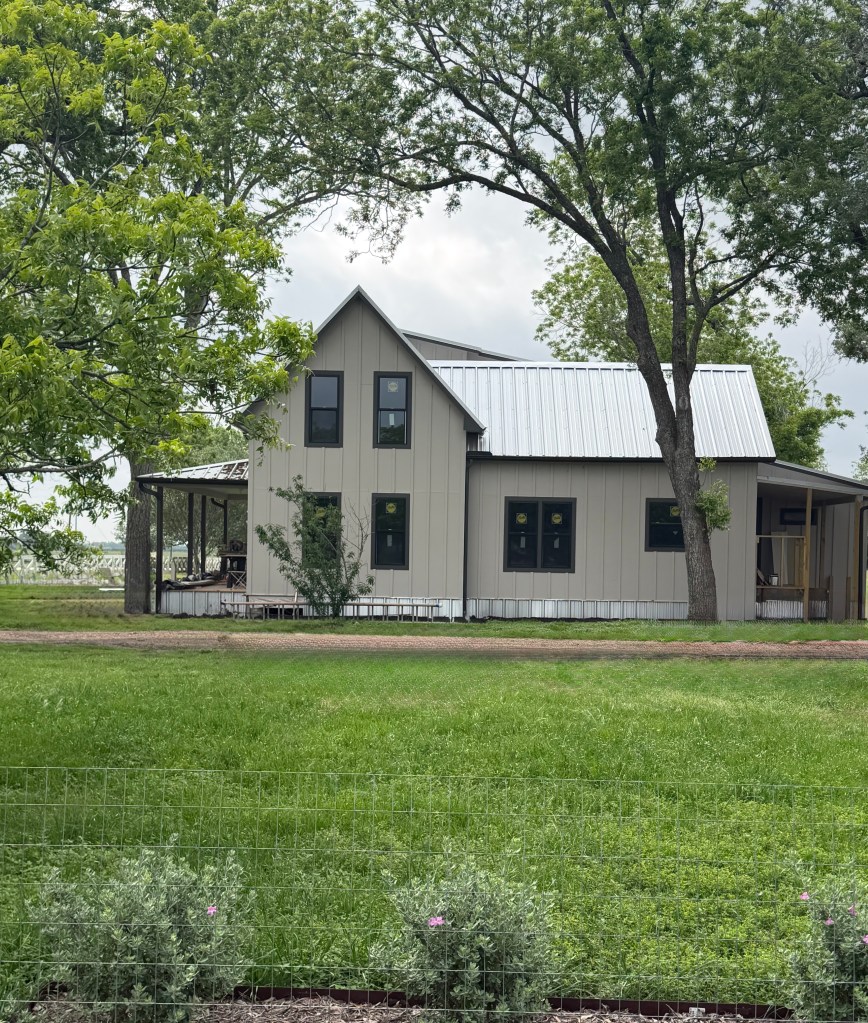
The next step was taking it to Keith. He said he didn’t see it at first, but also said what I needed to hear: if it’s bothering you, we need to fix it now.
He kindly had the conversation with our contractor.
As it turns out, the change wasn’t nearly as costly as I had feared. The primer and trim were already complete, which softened the impact. Still, it was a decision—a small hit to the pocketbook, but one that felt worth making.
Because I couldn’t imagine driving up to that house for years to come and only seeing that muted, doughy pinkish hue.
Somewhere in all of this, I found myself asking a different question:
Why are white farmhouses so enduring?
It turns out, the answer is far more practical than aesthetic. Historically, white paint was often the most affordable option. Lime-based washes were not only economical, but also helped repel insects and prevent mildew.
What we now see as a design choice… began as necessity.
That realization shifted something for me.
I didn’t want to return to a stark white—but I did want to move closer to that sense of lightness. Something softer. Something that honored the history without feeling flat or expected.
The color we landed on is Oyster White.

Despite its name, it isn’t truly white at all. It’s a gentle, light taupe—subtle, but present in the right way. When we placed the sample on the exterior wall, it immediately felt different. It didn’t compete with the house.
It let the house speak.
There was a clarity to it. A quiet brightness that the previous color had muted.
We’re hoping to have it painted next month. When it is, I’ll share before and after photos—the kind that tell the story better than words can. I’ll also include the color swatches, for anyone else standing where I stood, trying to find the right balance between intention and instinct.
Because if this process has taught me anything, it’s this:
Renovating a house with history isn’t about getting it right the first time.
It’s about learning to listen… and having the courage to begin again.

Share you thoughts